

On this page
What is cymatics, exactly?
A plate, membrane or other surface is vibrated, and a thin layer of sand, powder, paste or liquid shows which parts are moving and which are still. The word comes from the Greek for “wave” and was coined by the Swiss physician Hans Jenny (1904 to 1972), who published the first of two volumes on the subject, Kymatik, in 1967.
Why does the sand make lines?
When a plate vibrates at one of its natural (resonant) frequencies, it settles into a standing wave. Some areas move up and down a lot. Other lines across the plate barely move at all. These still lines are called nodes, or nodal lines.
Sand on the moving parts gets bounced away. Sand that lands on a nodal line stays put. After a few seconds, almost all the sand has collected on the nodes, and you are looking at a map of where the plate is still. UC Santa Barbara’s physics demonstration notes put it simply: the sand moves away from the antinodes and settles in the nodes.
Why does each note give a different pattern?
A plate only forms a clear pattern at certain frequencies, its resonant modes. Each mode has its own arrangement of nodal lines, so each one draws a different figure.
- Higher notes, busier patterns. The University of Colorado Boulder’s demonstration shows square plate patterns getting more intricate as the frequency rises, with extra nodes dividing the plate into smaller cells.
- Shape matters. A circular plate tends to give rings, while a square plate gives symmetric lines. Triangles and irregular shapes give their own patterns.
- How the plate is held matters too. Colorado’s notes tie the patterns to the plate’s boundary conditions, meaning where and how it is fixed.

Who discovered Chladni patterns?
The patterns are named after Ernst Chladni (1756 to 1827), a German physicist and musician. In 1787 he published Entdeckungen über die Theorie des Klanges (“Discoveries in the Theory of Sound”), describing how he drew a bow along the edge of a sand covered metal plate until it resonated. The sand patterns he recorded are still called Chladni figures today. He was not quite the first: Wikipedia’s article on Chladni notes that in 1680 Robert Hooke ran a violin bow along the edge of a flour covered glass plate and saw similar nodal patterns appear.

Michael Faraday later found that a liquid in a vibrating bowl also forms regular patterns, now known as Faraday waves.
How can you see it for yourself?
The university demonstrations all use the same basic kit, and you can copy the idea on a small scale:
- A thin, flat plate. UC Santa Cruz uses aluminium plates. The UC Santa Barbara plates are about 24 cm across, under a millimetre thick, and mounted at the centre.
- A way to make it vibrate. Labs use a signal generator driving a mechanical vibrator, which works much like a loudspeaker. Chladni used a violin bow on the edge.
- Sand or salt. Use only a light sprinkle. UC Santa Barbara notes that too much sand adds mass and makes the higher modes hard to excite.
- Sweep the frequency slowly. Patterns only snap into place at resonance, so move through the notes gently and pause when the sand starts to gather.
Questions people ask
What are Chladni figures?
The patterns sand forms on a vibrating plate. The sand collects along the nodal lines, the parts of the plate that are not moving.
Who coined the word?
Hans Jenny, a Swiss physician, who published Kymatik in 1967. The patterns themselves are named after Ernst Chladni, who described them in 1787.
Why do higher notes make more complicated shapes?
Higher resonant modes have more nodes, so the plate is divided into smaller cells (University of Colorado Boulder).
Does it only work with sand?
No. Powder, paste or liquid can also show the pattern, and Faraday found regular patterns in liquids.
Where Cymatics Art helps, and where it does not
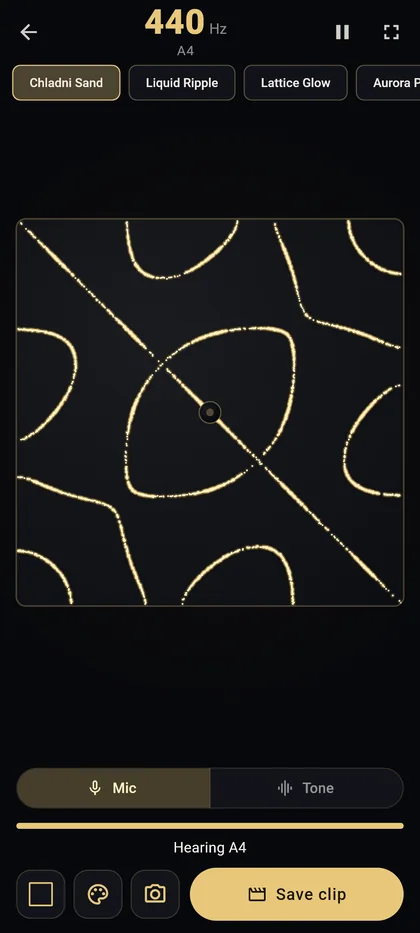
Cymatics Art is our Android app for exploring these patterns without a plate. Sing, hum, whistle or play an instrument near your phone, or play a tone with the slider, and thousands of grains of sand bounce off the moving parts of a square, circular or violin shaped plate and gather on the still lines. Change the note and the sand moves to a new pattern. It is free with the square plate and three styles; a one-time Pro unlock adds the circle and violin plates, three more styles, your own colours and longer clips. Microphone sound is used on your phone and never uploaded.


What it is good for: getting a feel for the idea that each pitch draws its own shape, playing with sound and pattern, and making something lovely to watch.
What it will not do: the app is a sound art toy, and it does not simulate one particular physical plate. A real plate’s patterns depend on its size, material, thickness and how it is held, so the frequencies on screen will not match the ones a plate on your desk needs. It does not work as a spectrum analyser or a lab instrument either. For real measurements, or to see true Chladni figures, use a physical plate.
Questions or bugs: Email us.
Sources
- CymaticsWikipedia en.wikipedia.org
- Ernst ChladniWikipedia en.wikipedia.org
- 44.45 Chladni platesUC Santa Barbara Physics web.physics.ucsb.edu
- Chladni FiguresUniversity of Colorado Boulder physicslabs.colorado.edu
- Chladni FiguresUC Santa Cruz ucscphysicsdemo.sites.ucsc.edu