
On this page
What is the phonics screening check?
The phonics screening check is a short statutory check run by schools in England. Its stated purpose is to confirm that children have learned phonic decoding to an age appropriate standard. In plain terms, it checks whether your child can look at a word they have not seen before, work out the sounds the letters make, and blend those sounds into a word.
With some exceptions, every child who turns 6 by the end of the school year takes it, so for most children that means Year 1. Schools use the results to spot who needs extra support. The government does not publish results for individual schools.
When is the check in 2027?
Schools must give the check in the week starting Monday 14 June 2027. If your child is away that week, the school can give it the following week, 21 to 25 June. Year 2 children who did not meet the standard in 2026, or have not taken the check before, take it in the same week.
Year 4 children have their own statutory check at around the same time: the multiplication tables check runs for two weeks from Monday 7 June 2027.
What does the check look like?
The check has 40 words in two sections of 20. Both sections mix real words and pseudo-words, which are made-up words that follow normal spelling patterns. Each pseudo-word is shown next to a picture of an imaginary creature, so children know it is the creature’s name and not a word they should recognise. That stops them turning it into a real word they already know.
Words appear four to a page, and before each page the adult says whether the words are real words or creature names. Section 2 uses longer words and harder spellings than Section 1. You can see the step up in the made-up words from the 2026 check: Section 1 included jad, kib and skop, while Section 2 included phime, gloast and splace.
Before the check starts, your child goes through a practice sheet with four made-up words and four real words, so they know what to expect.
How is it given and marked?
- One to one, with an adult your child knows. Usually a teacher or teaching assistant, in a quiet room. It cannot be a parent or relative.
- No time limit. Most children finish in about 4 to 9 minutes, and breaks are allowed. If a child is really struggling, the adult can stop early.
- Sounding out is allowed, but the blend counts. Your child may say the sounds first, but must then blend them into the word. Sounds on their own are marked as incorrect.
- Self-corrections count. The final attempt is the one that is scored.
- Accents are fine. Regional pronunciations are accepted, and a made-up word can be read in any plausible way. Real words need the right sound, though, so the ow in blow should not sound like the ow in cow.
- No feedback on each word. The adult will not say whether a word was right or wrong, though they may encourage your child.
What do the results mean?
Each word read correctly scores one mark, out of 40. The mark needed to meet the expected standard is only published after the check. In 2026 it was 31, the first change since the check began in 2012, when it was 32. Nationally, 82% of Year 1 pupils met the expected standard in 2026, and 89% had met it by the end of Year 2.
Your child’s teacher will share the score with you in the second half of the summer term. If your child found it difficult, the school should tell you what support they are putting in place, and your child will take the check again in Year 2. The check finds children who need more help with decoding; it does not measure how much your child enjoys or understands books.
How can you help at home?
- Read together every day. When your child meets a new word, encourage them to sound it out and blend from left to right instead of guessing from the pictures, then talk about what it means.
- Ask for decodable books. The teacher can suggest books written with the sounds your child has learned. Use the reading record to share what went well.
- Use the school’s sounds. Children usually start with letters such as s, a and t, then sounds such as ee, ch and ck, and later igh and air. Say sounds the way the school teaches them.
- Play with made-up words. Write a few and draw a silly creature beside each. A creature’s name is not a real word, so the job is to read exactly what is written.
- Look at a past check. Each year’s check is published afterwards. Reading a few pages of the 2026 materials together makes the format familiar.
- Keep it calm. A few minutes at a time is plenty. Stop while it is still fun, praise effort, and try not to make June feel like a big exam.
Questions people ask
Can my child fail the phonics check?
Not in the sense of an exam. A child either meets the expected standard or does not yet, and children who do not meet it get extra support and take the check again in Year 2.
Does every child take it?
Most do. A head teacher can decide a child should not take it, for example if they have just arrived and cannot yet understand letters and sounds in English. The school must tell you why and explain how it is supporting your child.
Is there a phonics check in Wales, Scotland or Northern Ireland?
Not this one. The phonics screening check is for schools in England.
Where School Checks helps, and where it does not
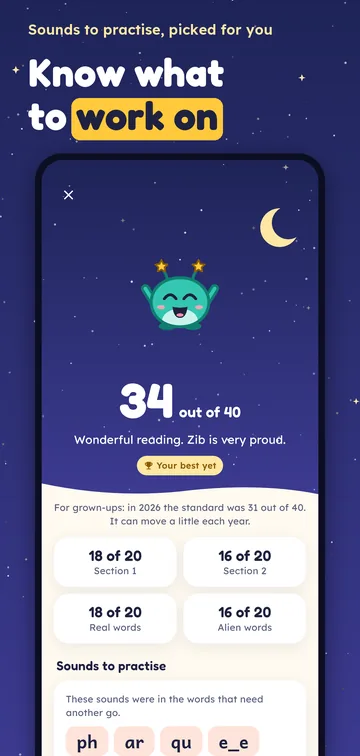
School Checks is our Android app for practising the Year 1 phonics check and the Year 4 times tables check at home, coming soon to Google Play. Its phonics practice checks follow the published structure, with 40 new words of our own each time. Your child reads aloud and you mark each word, with help showing how each made-up word can be read. Afterwards you see the score by section and the sounds to practise, picked from the words that were missed.

Free: your first phonics and times tables practice checks, single letter sounds, the 2, 5 and 10 times tables, and one child. Pro is a school year plan or a one-time lifetime unlock, with the same features either way.
What it is good for: short, calm practice that makes the format familiar and shows you which sounds need work.
What it will not do: it does not listen to your child. In our tests offline speech recognition could not judge made-up words reliably, so a grown-up marks each word. A practice score is a guide, not a prediction, and no app replaces reading books together or your school’s phonics teaching. School Checks is made by Zarkon, an independent UK app studio, and is not made by, linked to or approved by the Standards and Testing Agency or the Department for Education.
Questions or ideas: Email us.
Sources
- Phonics screening check: information for parentsStandards and Testing Agency gov.uk
- 2027 phonics screening check assessment and reporting arrangementsStandards and Testing Agency gov.uk
- Primary assessments: future datesStandards and Testing Agency and Department for Education gov.uk
- Phonics screening check: administration guidanceStandards and Testing Agency gov.uk
- Phonics screening check: 2026 materialsStandards and Testing Agency gov.uk
- Phonics screening check attainment, 2025/26Department for Education explore-education-statistics.service.gov.uk